Calculating risk probability and impact matrix is a crucial step in risk assessment and decision making in project management. It is a tool that helps you identify, analyse, and evaluate potential risks associated with a project.
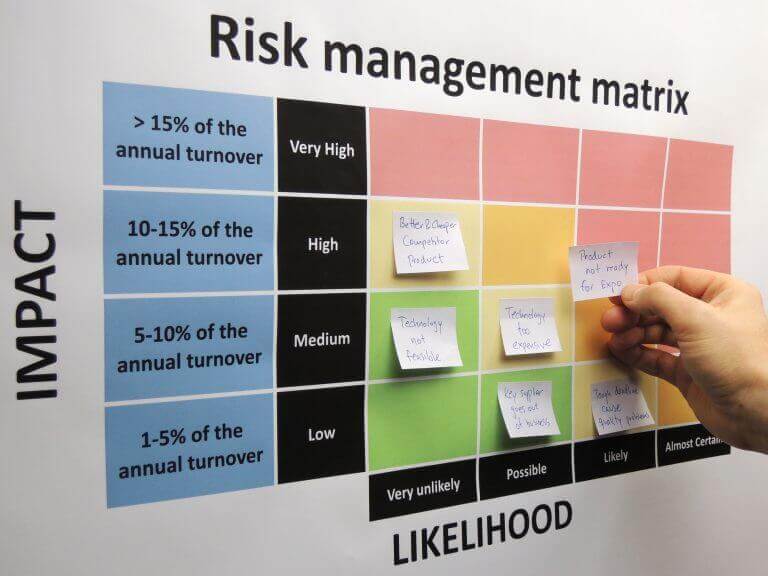
The risk probability and impact matrix is a visual representation of the likelihood of a risk occurring and its potential impact on the project.
To calculate the risk probability and impact matrix, you need to identify the risks associated with your project and assess the likelihood of each risk occurring. You also need to evaluate the potential impact of each risk on the project.
Once you have identified the risks and assessed their likelihood and impact, you can plot them on the matrix and determine the appropriate risk response strategy.
There are several risk analysis techniques that you can use to calculate the risk probability and impact matrix, including qualitative, semi-quantitative, and quantitative methods. The choice of technique depends on the complexity of the project, the resources available, and the level of accuracy required.
Key Takeaways
- The risk probability and impact matrix is a visual representation of the likelihood of a risk occurring and its potential impact on the project.
- To calculate the risk probability and impact matrix, you need to identify the risks associated with your project and assess the likelihood of each risk occurring.
- There are several risk analysis techniques that you can use to calculate the risk probability and impact matrix.
Understanding Risk in Project Management
Defining Risk and Its Components
Risk management is a critical aspect of project management. Risk is defined as the likelihood or probability of an event occurring that will have an impact on the project’s objectives. Risk is a combination of two components, probability and impact. Probability is the likelihood of an event occurring, and impact is the effect that the event will have on the project objectives.
Risk can be either positive or negative. Positive risks are opportunities that can have a beneficial impact on the project objectives. Negative risks are threats that can have a detrimental impact on the project objectives. It is essential to identify both types of risks and manage them accordingly.
The Role of Probability and Impact in Risk Assessment
Probability and impact are critical components of risk assessment. Probability is the likelihood of an event occurring, and impact is the effect that the event will have on the project objectives. The probability and impact of a risk are used to assess the overall risk level.
Probability is usually expressed as a percentage or a probability rating. Impact is usually expressed in terms of cost, schedule, quality, or scope. The risk matrix is a tool used to assess the probability and impact of a risk. The risk matrix helps to identify the overall risk level, which is used to determine the appropriate risk response strategy.
The project manager is responsible for identifying, assessing, and managing risks. The project manager must work with the project team to identify risks and develop risk response strategies. The project manager must also monitor and control risks throughout the project lifecycle.
In conclusion, understanding risk and its components is critical to effective risk management in project management. Probability and impact are essential components of risk assessment, and the risk matrix is a tool used to assess the overall risk level. The project manager is responsible for identifying, assessing, and managing risks throughout the project lifecycle.
Components of the Risk Probability and Impact Matrix
When it comes to calculating the risk probability and impact matrix, there are a few key components that you need to consider. These components include designing the matrix structure, defining probability levels, and assessing impact severity. Let’s take a closer look at each of these components:
Designing the Matrix Structure
The first step in creating a risk probability and impact matrix is to design the matrix structure. This involves creating a table with rows and columns to represent the likelihood and consequence of different risks. The table should be divided into sections that represent different risk levels, such as low, medium, and high.
Defining Probability Levels
Once you have designed the matrix structure, you need to define the probability levels. Probability levels represent the likelihood of a risk occurring, and are typically represented as a percentage. For example, you might define a probability level of 10% to represent a low likelihood of a risk occurring, while a probability level of 90% might represent a high likelihood.
Assessing Impact Severity
The final component of the risk probability and impact matrix is assessing impact severity. This involves determining the severity of the impact that a risk would have if it were to occur. Impact severity is typically represented as a score, with higher scores indicating more severe impacts. For example, you might assign a severity score of 1 to represent a low impact, while a score of 5 might represent a high impact.
Once you have defined the probability levels and assessed the impact severity, you can use this information to calculate the risk level for each risk. This is typically done by multiplying the probability level by the impact score. The resulting number represents the risk level, with higher numbers indicating higher levels of risk.
In summary, the risk probability and impact matrix is a useful tool for assessing and managing risk. By designing the matrix structure, defining probability levels, and assessing impact severity, you can calculate the risk level for each risk and take appropriate action to mitigate those risks.
Calculating Risk Probability and Impact
When managing risks in a project, it is important to assess the likelihood of occurrence and the potential consequences of each risk. A probability and impact matrix can be used to rank risks and determine which ones require further attention. Here are the steps to calculate risk probability and impact:
Determining Likelihood of Occurrence
To determine the likelihood of a risk occurring, consider the following factors:
- Historical data: Look at past projects or experiences to see if similar risks have occurred.
- Expert judgement: Consult with experts in the field to get their opinion on the likelihood of the risk occurring.
- Data analysis: Use data to determine the frequency of the risk occurring.
Once you have gathered this information, you can assign a probability score to each risk. A common scale is 1 to 5, with 1 being the lowest probability and 5 being the highest.
Evaluating Consequences of Risks
To evaluate the consequences of a risk, consider the following factors:
- Impact assessment: Assess the potential impact of the risk on the project’s objectives, such as cost, schedule, and quality.
- Risk tolerance: Determine the level of risk that is acceptable for the project.
- Stakeholder analysis: Determine how the risk will affect stakeholders, such as customers, employees, and suppliers.
Once you have gathered this information, you can assign an impact score to each risk. A common scale is 1 to 5, with 1 being the lowest impact and 5 being the highest.
Using Formulas and Tools
To calculate the risk score, multiply the probability score by the impact score. For example, if a risk has a probability score of 3 and an impact score of 4, the risk score would be 12.
You can use Excel or other tools to create a probability and impact matrix. The matrix should have a range of scores for probability and impact, such as 1 to 5, and a ranking system for the risk scores, such as low, medium, and high. The matrix can be used to prioritize risks and determine which ones require further attention.
In summary, calculating risk probability and impact is an essential part of risk management. By following these steps and using formulas and tools, you can assess the likelihood of occurrence and potential consequences of each risk and prioritize them accordingly.
Risk Analysis Techniques
When conducting a risk analysis, it is important to consider several techniques to ensure that you have a comprehensive understanding of the risks involved. In this section, we will discuss three important techniques: qualitative vs quantitative analysis, risk data gathering and expertise, and root cause analysis.
Qualitative vs Quantitative Analysis
Qualitative risk analysis involves the identification and assessment of risks based on subjective criteria. This technique is useful when there is a lack of data or when the consequences of the risk are difficult to quantify. It involves the use of expert judgement and can be conducted through brainstorming, checklists, or interviews.
On the other hand, quantitative risk analysis involves the use of objective data to assess the likelihood and consequences of risks. This technique is useful when there is a large amount of data available and when the consequences of the risk can be quantified. It involves the use of mathematical models and statistical analysis.
Risk Data Gathering and Expertise
To conduct a comprehensive risk analysis, it is important to gather data from various sources. This can include historical data, industry standards, and expert opinions. Gathering data from multiple sources can help to identify potential risks and provide a more accurate assessment of the likelihood and consequences of those risks.
Expertise is also an important factor in risk analysis. Experts in the field can provide valuable insights into potential risks and can help to identify ways to mitigate those risks. It is important to involve experts in the risk analysis process to ensure that all potential risks are identified and assessed.
Root Cause Analysis
Root cause analysis is a technique used to identify the underlying causes of a risk. This technique involves asking “why” questions to identify the root cause of the risk. By identifying the root cause, it is possible to develop effective solutions to mitigate the risk.
In conclusion, conducting a comprehensive risk analysis involves several techniques, including qualitative vs quantitative analysis, risk data gathering and expertise, and root cause analysis. By using these techniques, you can identify potential risks and develop effective solutions to mitigate those risks.
Interpreting the Probability and Impact Matrix
When it comes to risk management, the Probability and Impact Matrix is a useful tool to help you identify, assess, and prioritise risks. However, interpreting the matrix can be a little tricky. In this section, we will explore how to read the matrix and use it to rate and prioritise risks.
Reading the Matrix
The matrix is typically presented as a two-dimensional table, with the probability of a risk occurring on the x-axis and the impact of the risk on the y-axis. The probability is usually expressed as a percentage, while the impact is rated on a scale of low, medium, and high.
To use the matrix, you need to first identify the risk severity by determining the intersection of the probability and impact axes. This will give you a risk rating, which can be used to prioritise risks based on their severity.
Risk Rating and Prioritisation
Once you have identified the risk severity using the matrix, you can use this information to prioritise risks. Risks with a high severity rating should be addressed first, followed by those with a medium severity rating. Risks with a low severity rating can be addressed last.
To help prioritise risks, you can use a heatmap to visually represent the severity of each risk. A heatmap is a graphical representation of data where the values are represented by colours. In the case of the Probability and Impact Matrix, the heatmap can be used to show the severity of each risk by colour-coding the cells in the matrix.
In summary, the Probability and Impact Matrix is a powerful tool for risk management. By understanding how to interpret the matrix, you can identify, assess, and prioritise risks effectively. Use the matrix to rate the severity of each risk and prioritise them accordingly. Use a heatmap to visually represent the severity of each risk and communicate this information to stakeholders.
Implementing Risk Response Strategies
Once you have identified and analysed the risks in your risk management plan, you need to implement risk response strategies to mitigate them. This involves developing mitigation plans and monitoring and reviewing risks.
Developing Mitigation Plans
Developing mitigation plans involves determining the best course of action to reduce the probability and impact of identified risks. This can be achieved by using a risk probability and impact matrix, which assesses the probability and impact of each risk and helps you prioritise them.
To develop a mitigation plan, you need to consider the following:
- The likelihood and impact of each risk
- The cost of implementing the mitigation plan
- The availability of resources to implement the plan
- The effectiveness of the mitigation plan in reducing the risk
Once you have developed a mitigation plan, you need to implement it and monitor its effectiveness.
Monitoring and Reviewing Risks
Monitoring and reviewing risks involves regularly assessing the effectiveness of your mitigation plans and making any necessary adjustments. This can be achieved by:
- Regularly monitoring the risks and the effectiveness of your mitigation plans
- Reviewing your risk management plan and updating it as necessary
- Communicating the risks and mitigation plans to stakeholders
By monitoring and reviewing risks, you can identify any new risks that may arise and adjust your mitigation plans accordingly. This ensures that your risk management plan remains effective and up-to-date.
In conclusion, implementing risk response strategies involves developing mitigation plans and monitoring and reviewing risks. By using a risk probability and impact matrix, you can prioritise the risks and develop effective mitigation plans. By regularly monitoring and reviewing risks, you can ensure that your risk management plan remains effective and up-to-date.
Incorporating Risk Management into Project Lifecycle
As a project manager, it is essential to incorporate risk management into the project lifecycle. This will help you identify potential risks, assess their probability and impact, and develop a plan to mitigate them. Here are some ways to align risk management with project objectives and allocate resources effectively.
Alignment with Project Objectives
The first step is to align risk management with project objectives. This means identifying the objectives of the project and understanding how risks can impact them. For example, if your project objective is to deliver a product within a certain timeframe, you need to identify the risks that could delay the project. Once you have identified the risks, you can assess their probability and impact and develop a plan to mitigate them.
Resource Allocation and Decision Making
The next step is to allocate resources effectively. This means identifying the resources needed to manage the risks and ensuring that they are available when needed. For example, you may need to allocate resources to conduct a risk assessment, develop a risk management plan, or implement risk mitigation strategies. In addition, you need to involve decision-makers in the risk management process. This means ensuring that they are aware of the risks and the impact they could have on the project objectives. You also need to provide them with the information they need to make informed decisions about risk management.
To summarise, incorporating risk management into the project lifecycle is essential for successful project delivery. By aligning risk management with project objectives and allocating resources effectively, you can identify potential risks, assess their probability and impact, and develop a plan to mitigate them. This will help you manage uncertainty and deliver your project within the desired timeframe and budget.
Advanced Considerations in Risk Assessment
When it comes to risk assessment, there are many factors to consider. In this section, we will delve into some of the more advanced considerations that you should keep in mind when calculating a risk probability and impact matrix.
Strategic and Operational Risks
When assessing risk, it’s important to distinguish between strategic and operational risks. Strategic risks are those that are related to the overall direction of the organisation, such as changes in the market or regulatory environment. Operational risks, on the other hand, are risks that are related to day-to-day operations, such as equipment failure or employee error.
To ensure that you have a comprehensive understanding of all the risks facing your organisation, it’s important to consider both strategic and operational risks when calculating your risk probability and impact matrix. This will help you to identify potential risks that may not be immediately obvious.
Influence of Historical Data and Expert Judgment
When calculating a risk probability and impact matrix, it’s important to consider both historical data and expert judgment. Historical data can provide valuable insights into past risks and their impact, which can help you to better understand the likelihood and potential impact of future risks.
Expert judgment, on the other hand, can help you to identify risks that may not be immediately apparent from historical data. Experts can provide valuable insights into emerging risks and potential future scenarios, which can help you to better prepare for the future.
It’s important to strike a balance between historical data and expert judgment when calculating your risk probability and impact matrix. By considering both sources of information, you can ensure that you have a comprehensive understanding of all the risks facing your organisation.
In conclusion, when calculating a risk probability and impact matrix, it’s important to consider a range of factors, including strategic and operational risks, historical data, and expert judgment. By taking a comprehensive approach to risk assessment, you can ensure that you are well-prepared for any potential risks that may arise.
Professional Standards and Certification
When it comes to calculating risk probability and impact matrix, adhering to professional standards and obtaining certification can help ensure accuracy and consistency in your approach. Here are some guidelines and certifications to consider:
Project Management Institute (PMI) Guidelines
The PMI provides a comprehensive guide to project management, including risk management. The PMI Risk Management Professional (PMI-RMP) certification is a globally recognized credential that demonstrates your expertise in risk management. The PMI-RMP exam covers areas such as risk identification, risk analysis, risk response planning, and risk monitoring and control. By following the PMI guidelines and obtaining the PMI-RMP certification, you can ensure that your risk management approach is aligned with industry best practices.
PMP Certification and Training
The Project Management Professional (PMP) certification is another globally recognized credential offered by the PMI. While the PMP certification is not specific to risk management, it covers project management as a whole, including risk management. The PMP exam covers areas such as project initiation, planning, execution, monitoring and controlling, and closing. By obtaining the PMP certification and undergoing PMP training, you can gain a deeper understanding of project management and how risk management fits into the bigger picture.
Overall, adhering to professional standards and obtaining certification can help you develop a more rigorous and consistent approach to risk management. Whether you choose to follow the PMI guidelines or pursue PMI-RMP or PMP certification, you can be confident in your ability to calculate risk probability and impact matrix accurately and effectively.
Frequently Asked Questions
How do you determine the numerical values for probability in a risk matrix?
The numerical values for probability are usually assigned based on expert judgement. There is no one-size-fits-all approach to assigning these values, but they are typically based on historical data, industry standards, and expert opinion. For example, you might assign a probability of 5% for a risk that has occurred once in the past 20 years, or a probability of 50% for a risk that occurs regularly.
What methodologies are employed to assess the impact of risks?
There are various methodologies that can be employed to assess the impact of risks. One common approach is to use a scale of severity, such as low, medium, and high. Another approach is to use a numerical scale, such as 1-10, to rate the severity of the impact. The impact can be assessed based on various factors, such as financial loss, reputational damage, and health and safety risks.
Can you describe the process for completing a Probability and Impact Matrix?
To complete a Probability and Impact Matrix, you will need to identify the risks that you are assessing, and then assign a probability and impact rating to each risk. The probability rating should be based on the likelihood of the risk occurring, and the impact rating should be based on the severity of the consequences if the risk does occur. Once you have assigned ratings to each risk, you can then plot them on a matrix to visualise the overall risk profile.
What are the primary categories used to classify risk impact?
The primary categories used to classify risk impact are financial, reputational, legal, operational, and health and safety. Financial risks relate to the potential for financial loss, reputational risks relate to damage to the organisation’s reputation, legal risks relate to compliance with laws and regulations, operational risks relate to the smooth running of the organisation, and health and safety risks relate to the physical wellbeing of employees and stakeholders.
In what ways can a risk assessment matrix be utilised to enhance decision-making?
A risk assessment matrix can be utilised to enhance decision-making by providing a visual representation of the risks associated with a particular course of action. By assessing the probability and impact of each risk, decision-makers can make informed decisions about how to mitigate or manage the risks. The risk assessment matrix can also be used to prioritise risks and allocate resources accordingly.
What is the standard equation for quantifying risk based on probability and severity?
The standard equation for quantifying risk based on probability and severity is Risk = Probability x Impact. This equation is used to calculate the overall risk rating for each identified risk in the Probability and Impact Matrix. The risk rating can then be used to prioritise risks and allocate resources accordingly.