Diversification is a growth strategy that involves entering new markets or creating new products outside of an organization’s existing operations. It is one of the four strategies presented in the Ansoff Matrix, a popular tool used by businesses to plan their growth strategies.
The Ansoff Matrix helps organizations identify potential opportunities for growth by analyzing the relationship between their existing products and markets, as well as the potential for new products and markets.
Diversification is a complex strategy that requires careful planning and execution. It can be achieved through two main approaches: related diversification and unrelated diversification.
Related diversification involves expanding into markets or products that are related to an organization’s existing operations, while unrelated diversification involves entering completely new markets or industries.
Implementing a diversification strategy can help organizations reduce risk and increase their chances of success by spreading their operations across multiple markets and products.
Key Takeaways
- The Ansoff Matrix is a popular tool used by businesses to plan their growth strategies.
- Diversification is a growth strategy that involves entering new markets or creating new products outside of an organization’s existing operations.
- Implementing a diversification strategy can help organizations reduce risk and increase their chances of success by spreading their operations across multiple markets and products.
Understanding the Ansoff Matrix
The Ansoff Matrix is a strategic planning tool that helps businesses identify growth opportunities based on their products and markets. It was developed by Igor Ansoff in 1957 and has since been widely used by businesses of all sizes to plan their growth strategies.
Core Concepts
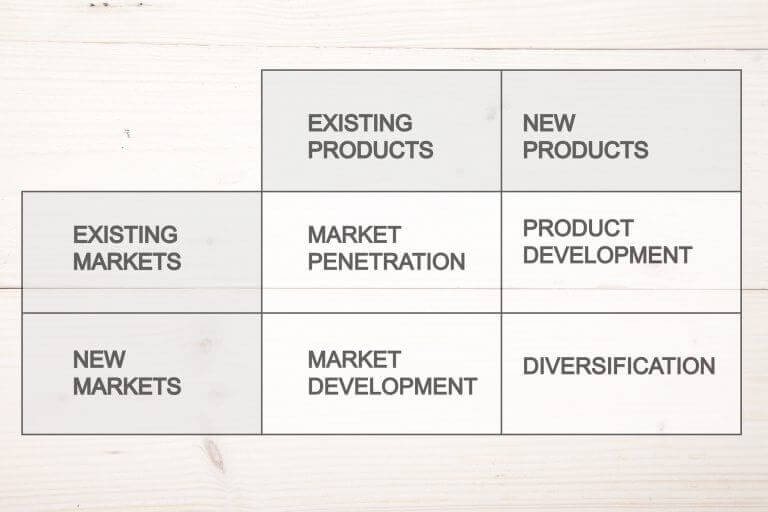
The Ansoff Matrix consists of four growth strategies, each of which corresponds to a different combination of products and markets. These strategies are:
- Market Penetration: This strategy involves increasing sales of existing products in existing markets. It often involves increasing market share by offering promotions or improving customer service.
- Product Development: This strategy involves creating new products for existing markets. It often involves research and development to create products that meet the needs of existing customers.
- Market Development: This strategy involves selling existing products in new markets. It often involves expanding into new geographic regions or targeting new customer segments.
- Diversification: This strategy involves creating new products for new markets. It often involves entering entirely new industries or markets.
Importance in Strategic Planning
The Ansoff Matrix is an important tool for businesses because it helps them identify growth opportunities and choose the best strategies for achieving their goals. By understanding the different growth strategies and the risks and rewards associated with each one, businesses can make informed decisions about how to allocate their resources and plan for the future.
When using the Ansoff Matrix, businesses should consider factors such as their current market position, the competitive landscape, and the resources available to them. They should also consider the potential risks and rewards associated with each growth strategy, and choose the one that best aligns with their overall business goals.
In conclusion, the Ansoff Matrix is a powerful tool for businesses looking to grow and expand their operations. By understanding the core concepts and importance of the matrix, businesses can make informed decisions about their growth strategies and position themselves for long-term success.
Diversification Strategy
Diversification is a strategy used by businesses to expand their operations and reduce risk by entering new markets or developing new products. In the Ansoff Matrix, diversification is one of the four growth strategies available to companies. This section will cover the definition and purpose of diversification, types of diversification, and the risks and rewards associated with this strategy.
Definition and Purpose
Diversification is a strategy that involves entering new markets or developing new products that are unrelated to the company’s existing business. The purpose of diversification is to reduce risk by spreading a company’s operations across different markets and products. By doing so, a company can reduce its reliance on a single product or market and increase its chances of long-term success.
Types of Diversification
There are two types of diversification: related and unrelated. Related diversification involves entering a new market or developing a new product that is related to the company’s existing business. For example, a company that produces cars may decide to start manufacturing motorcycles. Unrelated diversification involves entering a new market or developing a new product that is unrelated to the company’s existing business. For example, a company that produces cars may decide to start manufacturing clothing.
Risks and Rewards
Diversification can provide a number of rewards, including increased revenue, reduced risk, and access to new markets. However, it also comes with risks. For example, entering a new market or developing a new product requires a significant investment of time and resources. If the new market or product is not successful, the company may lose money. Additionally, unrelated diversification can be risky because the company may not have the expertise or resources necessary to succeed in the new market or product.
In conclusion, diversification is a strategy that can help companies reduce risk and increase their chances of long-term success. However, it also comes with risks that must be carefully considered before entering new markets or developing new products.
Implementing Diversification
Diversification is a growth strategy that involves entering new markets with new products. The Ansoff Matrix is a useful tool for identifying opportunities for diversification. Here are some steps to implement diversification in your business:
Identifying Opportunities
Identifying opportunities for diversification requires a thorough understanding of your business and the market. You can use market research to identify gaps in the market that your business can fill. You can also look at your existing products and services and identify areas where you can expand.
Assessing Business Risks
Diversification involves risk, so it’s important to assess the potential risks before implementing a diversification strategy. You should consider the potential impact on your existing business, the financial risks involved, and the potential impact on your reputation.
Strategic Execution
Once you have identified opportunities and assessed the risks, it’s time to execute your diversification strategy. This involves creating a marketing strategy and a marketing plan to promote your new products and services. You should also leverage your existing customer base to promote your new products and services.
Overall, diversification can be a powerful growth strategy if implemented correctly. By identifying opportunities, assessing business risks, and executing your strategy effectively, you can achieve long-term growth for your business.
Case Studies of Diversification
Successful Diversification
Diversification is a growth strategy that can be rewarding when executed successfully. One example of successful diversification is the Walt Disney Company. Disney started as an animation studio, but over time, it diversified into theme parks, television networks, and even cruise lines. This diversification helped the company reach new markets and increase revenue. By expanding its product offerings and entering new markets, Disney was able to reduce its dependence on any one product or market.
Another company that successfully diversified is Amazon. Initially, Amazon was an online bookstore, but it has since diversified into a wide range of products and services, including cloud computing, streaming video, and even grocery stores. This diversification has helped Amazon become one of the largest companies in the world.
Challenges in Diversification
While diversification can be rewarding, it also comes with risks. One challenge is that diversification can be expensive. Entering new markets or developing new products requires a significant investment of time and money. There is also the risk that the new products or markets may not be as profitable as expected, which can lead to financial losses.
Another challenge is that diversification can be complex. Managing a diverse portfolio of products or markets requires a high level of expertise and resources. Companies that are not able to effectively manage their diversified portfolio may struggle to achieve the benefits of diversification.
In conclusion, diversification can be a powerful growth strategy for companies looking to expand their product offerings and enter new markets. However, it comes with risks and challenges that must be carefully considered. Companies that are able to successfully diversify can reduce their dependence on any one product or market and increase their revenue.
Evaluating Diversification Performance
When it comes to evaluating diversification performance, there are several metrics that can be used. Two common metrics are market share analysis and financial metrics.
Market Share Analysis
Market share analysis is an important tool for evaluating the success of a diversification strategy. This involves looking at the company’s market share in the new market it has entered. If the company has been successful in gaining market share, it suggests that the diversification strategy has been effective.
To conduct a market share analysis, you need to determine the size of the market and the company’s share of that market. This can be done by looking at sales data for the company and its competitors. You can also use surveys to determine customer preferences and buying habits.
Financial Metrics
Financial metrics are another important tool for evaluating diversification performance. These metrics can help you determine whether the company’s diversification strategy is generating a return on investment.
One financial metric that is commonly used is return on investment (ROI). This measures the amount of profit generated by the investment relative to the cost of the investment. Another important financial metric is sales growth. This measures the rate at which sales are growing over time.
Other financial metrics that may be relevant include net present value (NPV), internal rate of return (IRR), and payback period. These metrics can help you determine the potential return on investment for the diversification strategy.
By using market share analysis and financial metrics, you can evaluate the success of your diversification strategy. This will help you determine whether the strategy is generating a return on investment and whether it is meeting the needs of your stakeholders.
Tools and Frameworks
When using the Ansoff Matrix, it’s important to consider various tools and frameworks to help you make informed decisions about diversification. Here are two popular ones:
SWOT Analysis
SWOT analysis is a tool used to identify a company’s strengths, weaknesses, opportunities, and threats. By examining these four areas, you can gain a better understanding of your company’s current situation and determine how to move forward with diversification.
To conduct a SWOT analysis, you need to identify your company’s internal strengths and weaknesses, as well as external opportunities and threats. You can then use this information to develop a plan for diversification that takes advantage of your strengths, addresses your weaknesses, and maximises opportunities while minimising threats.
Product/Market Expansion Grid
The Product/Market Expansion Grid is a framework that helps you identify potential product and market combinations for diversification. It consists of four categories: market penetration, market development, product development, and diversification.
Market penetration involves selling more of your existing products in your current market. Market development involves selling your existing products in new markets. Product development involves creating new products for your current market. Diversification involves creating new products for new markets.
To use the Product/Market Expansion Grid, you need to identify your target market, market segments, and customer needs. You can then use this information to determine which of the four categories to focus on for diversification.
By using these tools and frameworks, you can make informed decisions about diversification and develop effective marketing strategies that meet the needs of your target market.
Market Dynamics and Diversification
When it comes to the Ansoff Matrix, diversification is the most risky strategy as it involves entering a completely new market with a new product. However, it can also be the most rewarding strategy if executed correctly. In order to successfully implement a diversification strategy, it is important to understand the market dynamics and customer segmentation.
Competitor Analysis
Before entering a new market, it is important to conduct a competitor analysis. This will help you identify the strengths and weaknesses of your competitors and determine how you can differentiate your product from theirs. You can use tools such as SWOT analysis and Porter’s Five Forces to evaluate the competition.
Customer Segmentation
Customer segmentation is the process of dividing a market into smaller groups of customers with similar needs and characteristics. This allows you to tailor your product and marketing strategy to each segment. When entering a new market, it is important to conduct market research to identify the different customer segments and their needs. This will help you determine which segments to target and how to position your product.
In conclusion, diversification can be a risky but rewarding strategy if executed correctly. Conducting a competitor analysis and customer segmentation can help you identify opportunities and mitigate risks. By understanding the market dynamics and customer segmentation, you can develop a successful diversification strategy and enter a new market with confidence.
Marketing and Promotion
When it comes to diversification in Ansoff Matrix, marketing and promotion play a vital role in the success of a company. In this section, we will discuss two important aspects of marketing and promotion: advertising strategies and packaging and distribution.
Advertising Strategies
Advertising is an essential element of any marketing strategy. It is the process of creating awareness and promoting a product or service to potential customers. In the case of diversification, companies need to develop advertising strategies that are suitable for their new product or service.
One of the most common advertising strategies is to use existing media channels to reach new customer segments. For example, if a company is diversifying into a new market segment, it may need to use different advertising channels to reach this new audience.
Another advertising strategy is to promote the new product or service alongside existing products. This approach can help to leverage the existing customer base and create a sense of continuity between the old and new products.
Packaging and Distribution
Packaging and distribution are also important aspects of marketing and promotion. Packaging can help to differentiate a product from its competitors and create a unique brand identity. In the case of diversification, companies may need to develop new packaging designs that are suitable for the new product or service.
Distribution channels are also critical to the success of a new product or service. Companies need to identify the most appropriate distribution channels for their new product or service. This may involve using existing distribution channels or developing new ones.
In conclusion, marketing and promotion are essential elements of diversification in Ansoff Matrix. Companies need to develop advertising strategies that are suitable for their new product or service and identify the most appropriate distribution channels. By doing so, they can create a successful diversification strategy and expand their business into new markets.
Frequently Asked Questions
How does diversification fit within the Ansoff Matrix framework?
Diversification is one of the four growth strategies outlined in the Ansoff Matrix. The Ansoff Matrix is a strategic planning tool that helps businesses identify potential areas for growth. Diversification is the riskiest of the four strategies and involves entering a new market with a new product. This strategy is often pursued when the current market is saturated, or when the business wants to reduce its dependence on a single product or market.
What constitutes a diversification strategy according to the Ansoff Matrix?
A diversification strategy involves entering a new market with a new product. This can be achieved through two approaches: conglomerate diversification and related diversification. Conglomerate diversification involves entering a market that is unrelated to the existing business. Related diversification, on the other hand, involves entering a market that is related to the existing business.
Can you provide an illustration of a company successfully implementing a diversification strategy as outlined by the Ansoff Matrix?
One example of a company that successfully implemented a diversification strategy as outlined by the Ansoff Matrix is Virgin Group. Virgin Group started as a music record company but has since diversified into various industries, including airlines, telecommunications, and finance.
What are the potential benefits and drawbacks of pursuing a diversification approach in the Ansoff Matrix?
The potential benefits of pursuing a diversification approach in the Ansoff Matrix include reducing dependence on a single product or market, increasing revenue streams, and taking advantage of economies of scale. However, the drawbacks of diversification include the risk of failure, the need for significant investment, and the potential for loss of focus on the core business.
In what ways can market development be distinguished from diversification in the context of the Ansoff Matrix?
Market development involves expanding the existing product into new markets. Diversification, on the other hand, involves entering a new market with a new product. The key difference between the two is that market development involves expanding the existing product line, while diversification involves entering a new market with a new product.
How should a business prepare for diversification as suggested by the Ansoff Matrix?
A business should prepare for diversification by conducting market research to identify potential new markets and products. The business should also evaluate its capabilities and resources to ensure it can successfully enter the new market. Finally, the business should develop a detailed plan for entering the new market, including marketing, sales, and distribution strategies.