If you’re a business owner or marketer, you’ve likely heard of the Ansoff Matrix. This strategic planning tool is used to evaluate potential growth opportunities for businesses and organizations. It was first introduced by Igor Ansoff, a Russian-American mathematician and business theorist, in 1957.
The Ansoff Matrix helps businesses identify new product and market opportunities and determine the best strategies to pursue them.
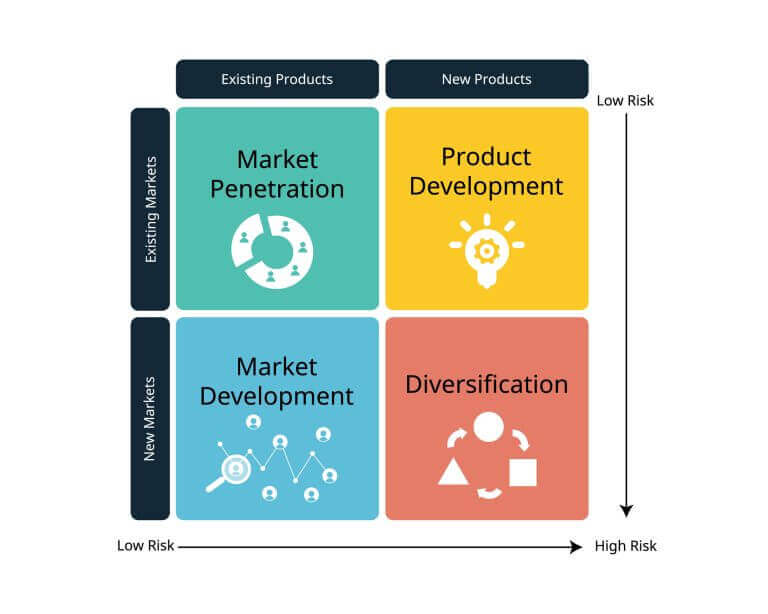
The Ansoff Matrix is a two-by-two grid that categorizes potential growth opportunities based on two factors: products and markets. The four categories are market penetration, product development, market development, and diversification. Market penetration involves selling more of your existing products to your existing customers.
Product development involves creating new products for your existing customers. Market development involves selling your existing products to new customers.
Diversification involves creating new products for new customers. By using the Ansoff Matrix, businesses can evaluate which category of growth strategy is the best fit for their current situation and goals.
Key Takeaways
- The Ansoff Matrix is a strategic planning tool used to evaluate potential growth opportunities for businesses and organizations.
- The Matrix categorizes potential growth opportunities based on two factors: products and markets.
- The four categories in the Ansoff Matrix are market penetration, product development, market development, and diversification.
Understanding the Ansoff Matrix
Definition
The Ansoff Matrix is a strategic planning tool that helps businesses determine their product and market growth strategy. It was developed by H. Igor Ansoff, an applied mathematician and business manager, in the 1960s. The matrix provides a framework for businesses to analyze their current and potential product and market offerings, and to identify opportunities for growth.
The Ansoff Matrix is a four-quadrant grid that categorizes products and markets into four categories: Market Penetration, Market Development, Product Development, and Diversification. Each quadrant represents a different strategy for growth, and businesses can use the matrix to determine which strategy is most appropriate for their current situation.
History and Origin
The Ansoff Matrix was first introduced in a 1957 paper by Igor Ansoff titled “Strategies for Diversification.” Ansoff was a Russian-American mathematician and business theorist who made significant contributions to the field of strategic management. He developed the Ansoff Matrix as a way to help businesses identify and evaluate growth opportunities.
The matrix was originally designed as a tool for analyzing diversification strategies, but it has since been applied to a wide range of strategic planning scenarios. Today, the Ansoff Matrix is widely used by businesses of all sizes and industries to identify growth opportunities and develop effective growth strategies.
In summary, the Ansoff Matrix is a powerful tool for strategic planning that can help businesses identify growth opportunities and develop effective growth strategies. By categorizing products and markets into four categories, businesses can determine which growth strategy is most appropriate for their current situation.
Applications of the Ansoff Matrix
The Ansoff Matrix is a useful tool for businesses to identify and evaluate growth opportunities. It can be applied to both strategic planning and marketing planning, as well as risk management. Here are some examples of how the Ansoff Matrix can be used:
Strategic Planning
The Ansoff Matrix can be used to identify growth strategies for a business. These strategies can be categorised into four quadrants: market penetration, market development, product development, and diversification. By analysing these quadrants, businesses can identify the most suitable growth strategy for their current situation.
For example, if a business is operating in a mature market with a high market share, it may choose to focus on market penetration by increasing sales of existing products. On the other hand, if a business is operating in a new market with low market share, it may choose to focus on market development by introducing existing products to new markets.
Marketing Planning
The Ansoff Matrix can also be used for marketing planning. By identifying which quadrant a product or service falls into, businesses can develop appropriate marketing strategies to promote their products or services.
For example, if a business is introducing a new product to an existing market, it may choose to use a product development strategy by promoting the unique features of the new product. On the other hand, if a business is introducing an existing product to a new market, it may choose to use a market development strategy by focusing on the benefits of the product for the new market.
Risk Management
The Ansoff Matrix can also be used for risk management. By identifying potential risks associated with each quadrant, businesses can develop appropriate risk management strategies to minimise the impact of these risks.
For example, if a business is pursuing a diversification strategy, it may face high risks associated with entering a new market or developing a new product. By identifying these risks, businesses can develop appropriate risk management strategies to minimise the impact of these risks.
In conclusion, the Ansoff Matrix is a versatile tool that can be used for strategic planning, marketing planning, and risk management. By identifying growth strategies and potential risks, businesses can make informed decisions to maximise their chances of success.
Growth Strategies in the Ansoff Matrix
The Ansoff Matrix is a strategic planning tool that helps businesses identify growth opportunities by analyzing four different types of growth strategies. These strategies are Market Penetration, Market Development, Product Development, and Diversification.
Market Penetration
Market Penetration is a growth strategy that focuses on increasing sales of existing products in existing markets. This can be achieved through various means, such as increasing the frequency of purchase, increasing the quantity of purchase, or expanding the customer base. Market Penetration is often the most straightforward and least risky growth strategy, as it leverages existing strengths and resources.
Market Development
Market Development is a growth strategy that focuses on expanding the customer base in new markets. This can be achieved through various means, such as identifying new customer segments, entering new geographic markets, or adapting products to meet the needs of new markets. Market Development requires a thorough understanding of the new market and a willingness to adapt to new customer needs.
Product Development
Product Development is a growth strategy that focuses on introducing new products or services to existing markets. This can be achieved through various means, such as developing new products, improving existing products, or expanding product lines. Product Development requires a willingness to invest in research and development and a willingness to take risks.
Diversification
Diversification is a growth strategy that focuses on introducing new products or services to new markets. This can be achieved through various means, such as entering new industries, acquiring new businesses, or developing new products for new markets. Diversification requires a willingness to take risks and a willingness to invest in new capabilities.
In conclusion, the Ansoff Matrix provides a useful framework for businesses to identify growth opportunities. By analyzing the four different types of growth strategies, businesses can make informed decisions about how to achieve sustainable growth.
Evaluating Market and Product Opportunities
When using the Ansoff Matrix, evaluating market and product opportunities is a crucial step. This involves conducting market research, analyzing SWOT (Strengths, Weaknesses, Opportunities, Threats), and segmenting customers based on their demographics and needs.
Market Research
Market research is the process of gathering information about the market and its potential customers. This can be done through surveys, focus groups, and other methods. The information gathered can help businesses identify market trends, customer needs, and potential opportunities.
SWOT Analysis
SWOT analysis is a tool used to evaluate a company’s strengths, weaknesses, opportunities, and threats. This can help businesses identify potential opportunities and areas where they need to improve. By conducting a SWOT analysis, businesses can develop strategies to take advantage of opportunities and mitigate potential threats.
Customer Segmentation
Customer segmentation involves dividing customers into groups based on their demographics and needs. This can help businesses tailor their products and marketing messages to specific customer groups. By understanding the needs of different customer segments, businesses can identify new opportunities for growth.
Overall, evaluating market and product opportunities is an essential step in using the Ansoff Matrix. By conducting market research, analyzing SWOT, and segmenting customers, businesses can identify new opportunities for growth and develop strategies to take advantage of them.
Implementing Ansoff Matrix Strategies
Once you have identified the appropriate growth strategy using the Ansoff Matrix, it is important to implement it effectively. This section will discuss some strategies for implementing Ansoff Matrix Strategies.
Promotion and Advertising
When implementing a strategy that involves promoting and advertising a product or service, it is important to consider the target audience. You should tailor your promotions and advertising to the specific needs and wants of your target market. For example, if you are targeting younger people, you might use social media platforms such as Instagram and Snapchat to promote your product. On the other hand, if you are targeting an older demographic, you might use more traditional forms of advertising such as television commercials and print ads.
Pricing Strategies
Pricing is an important factor in implementing a growth strategy. It is important to set a price that is competitive, yet profitable. You should also consider the perceived value of your product or service. If your product is perceived as being of high value, you may be able to charge a premium price. Conversely, if your product is perceived as being of low value, you may need to price it lower to remain competitive.
Distribution Channels
When implementing a strategy that involves changing distribution channels, it is important to consider the logistics of the new distribution channel. You should also consider the needs and wants of your target market. For example, if you are targeting a younger demographic, you might consider using online channels such as Amazon or eBay. On the other hand, if you are targeting an older demographic, you might use more traditional distribution channels such as brick and mortar stores.
In conclusion, implementing Ansoff Matrix Strategies requires careful consideration of your target market and the logistics of the new strategy. By tailoring your promotions, pricing, and distribution channels to the specific needs and wants of your target market, you can successfully implement a growth strategy.
Challenges and Considerations
When using the Ansoff matrix, there are several challenges and considerations that you should be aware of. These include competition analysis, risk assessment, and innovation and infrastructure.
Competition Analysis
One of the primary challenges you will face when using the Ansoff matrix is competition analysis. To determine which market penetration, product development, diversification, or market development strategy is best for your business, you need to have a clear understanding of your competitors. You will need to analyse their strengths, weaknesses, opportunities, and threats (SWOT analysis) to determine how you can differentiate yourself from them.
Risk Assessment
Another consideration when using the Ansoff matrix is risk assessment. Each strategy involves a different level of risk, and you need to evaluate the risks associated with each option. For example, market penetration is typically associated with lower risk, while diversification involves a higher level of risk. You need to evaluate your risk strategy and determine how much risk you are willing to take on.
Innovation and Infrastructure
Finally, innovation and infrastructure are also important considerations when using the Ansoff matrix. You need to determine whether your business has the necessary infrastructure to support your chosen strategy. For example, if you choose to diversify your product line, do you have the resources to support the development and marketing of new products? Additionally, you need to consider whether your business is innovative enough to successfully implement the chosen strategy.
In conclusion, using the Ansoff matrix involves several challenges and considerations. By carefully analysing your competition, evaluating your risk strategy, and considering your innovation and infrastructure, you can determine the best growth strategy for your business.
Case Studies and Real-world Examples
The Ansoff matrix is a useful tool for businesses to determine their product and market growth strategy. It is used to identify potential opportunities for growth and determine the best course of action to take. Here are some real-world examples of how the Ansoff matrix has been used in different situations.
Related Diversification
Related diversification is a growth strategy that involves expanding into new markets or creating new products that are related to the company’s existing products or markets. This strategy is often used to take advantage of the company’s existing strengths and capabilities.
For example, a company that produces sports equipment may decide to expand into the fitness market by creating a new line of fitness equipment. By doing so, they are able to use their existing knowledge of sports equipment to create a new product line that is related to their existing products.
Unrelated Diversification
Unrelated diversification is a growth strategy that involves expanding into new markets or creating new products that are not related to the company’s existing products or markets. This strategy is often used to reduce risk by diversifying the company’s portfolio.
For example, a company that produces sports equipment may decide to expand into the food industry by acquiring a restaurant chain. By doing so, they are able to diversify their portfolio and reduce their risk by entering a completely different industry.
Overall, the Ansoff matrix is a useful tool for businesses to determine their growth strategy. By using this tool, businesses can identify potential opportunities for growth and determine the best course of action to take. Whether it’s related or unrelated diversification, the Ansoff matrix can help businesses expand into new markets and create new products that will help them grow and succeed.
Future of Growth Strategies
As the business landscape continues to evolve, the future of growth strategies using Ansoff Matrix looks promising. With the growing importance of emerging markets and technological advancements, businesses can leverage these trends to expand their market share and increase profitability.
Emerging Markets
One of the key drivers of future growth strategies is the emergence of new markets and countries. As businesses continue to expand globally, they will need to consider new markets and countries to tap into. The Ansoff Matrix can help businesses identify and evaluate new markets and countries to enter.
Using the Ansoff Matrix, businesses can evaluate the potential risks and rewards of entering new markets. For example, businesses can use the matrix to evaluate the potential risks and rewards of entering a new market in terms of product development, market penetration, market development, and diversification.
Technological Advancements
Another key driver of future growth strategies is technological advancements. With the rapid pace of technological change, businesses must stay ahead of the curve to remain competitive. The Ansoff Matrix can help businesses identify and evaluate new technological advancements to leverage.
Using the Ansoff Matrix, businesses can evaluate the potential risks and rewards of investing in new technology. For example, businesses can use the matrix to evaluate the potential risks and rewards of investing in new technology in terms of product development, market penetration, market development, and diversification.
In conclusion, the Ansoff Matrix is a powerful tool that businesses can use to identify and evaluate growth strategies. With the growing importance of emerging markets and technological advancements, businesses that leverage the matrix can gain a competitive edge and increase profitability.
Conclusion
In conclusion, the Ansoff Matrix is a powerful tool that can help you identify the best growth strategy for your business. By considering your current products and markets, as well as potential new products and markets, you can make informed decisions about how to grow your business in a sustainable way.
Using the Ansoff Matrix can help you create value for your stakeholders by identifying new opportunities for growth. By expanding into new markets or developing new products, you can increase revenue and profits while also creating value for your customers.
When using the Ansoff Matrix, it is important to consider the needs and preferences of your stakeholders. By developing solutions that meet their needs, you can create a competitive advantage and differentiate yourself from your competitors.
Overall, the Ansoff Matrix is a valuable tool that can help you make informed decisions about how to grow your business. By considering your current products and markets, as well as potential new products and markets, you can identify the best growth strategy for your business and create value for your stakeholders.
Frequently Asked Questions
How is the Ansoff Matrix applied in strategic planning?
The Ansoff Matrix is a tool used to identify a company’s potential for growth by examining the relationship between its products and markets. It is most commonly used in strategic planning to help companies identify and evaluate potential growth opportunities. The matrix consists of four growth strategies: market penetration, market development, product development, and diversification. By analysing these strategies, a company can determine which direction to take in order to achieve growth.
What are the potential benefits and drawbacks of using the Ansoff Matrix?
The Ansoff Matrix provides a framework for companies to evaluate potential growth opportunities. It can help companies identify new markets, products, and services, as well as provide a way to evaluate the risks and benefits associated with each strategy. However, the matrix is not without its limitations. It can be difficult to apply in practice, and it may not always be clear which strategy is the best one to pursue. Additionally, the matrix does not take into account external factors that may impact a company’s growth potential.
In what ways can a company utilise market development according to the Ansoff Matrix?
Market development is one of the four growth strategies identified by the Ansoff Matrix. It involves expanding into new markets with existing products. This can be done by targeting new customer segments, entering new geographic areas, or expanding distribution channels. By utilising market development, a company can increase its customer base and revenue without having to develop new products or services.
How does the Ansoff Matrix guide a company in diversification strategies?
Diversification is another growth strategy identified by the Ansoff Matrix. It involves expanding into new markets with new products. This can be done by developing new products or services that are unrelated to the company’s current offerings, or by acquiring or merging with another company. The Ansoff Matrix can guide a company in diversification strategies by helping it evaluate the potential risks and benefits of entering new markets with new products.
Can you provide a real-world example where the Ansoff Matrix has been effectively implemented?
One real-world example of the Ansoff Matrix being effectively implemented is the case of Apple Inc. In the early 2000s, Apple was primarily known for its Macintosh computers. However, in 2001, the company introduced the iPod, a portable digital music player. This move represented a product development strategy, as Apple was introducing a new product to an existing market. Over time, Apple continued to expand its product line, introducing the iPhone and iPad, which represented a diversification strategy, as the company was entering new markets with new products.
What strategic themes are emphasised within the Ansoff Matrix framework?
The Ansoff Matrix emphasises several strategic themes, including market penetration, market development, product development, and diversification. Market penetration involves increasing sales of existing products in existing markets. Market development involves expanding into new markets with existing products. Product development involves developing new products or services for existing markets. Diversification involves entering new markets with new products or services. By examining these themes, a company can determine which growth strategy is the most appropriate for its needs.